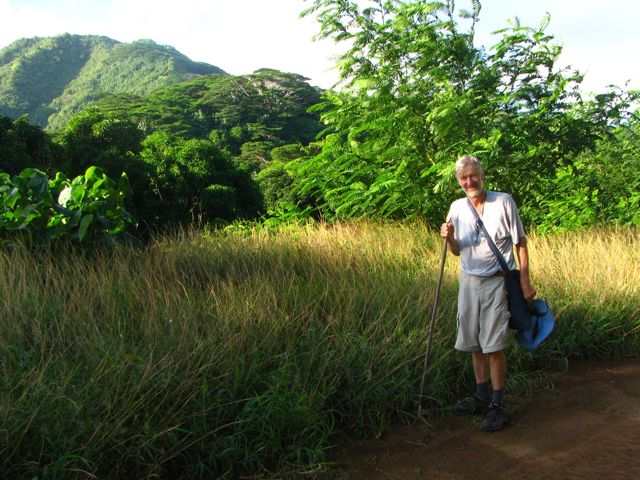
The new crew who joined us in Nuku Hiva were veterans Susanne, Annemarie and surprise arrival Maria


They arrived on July 14, which is ‘Bastille Day’, the most festive day in French Polynesia. The official parade in Taiohae was a line up of all what the island had to offer – traditional Polynesian matriarchs, proud Marquesan horse riders and representatives of all tribal, cultural and sports groups.


Time had come to leave the Marquesas, these frontier islands with its strong people and next on the itinerary was the 480 miles passage to the Tuamotus. Unfortunately for the newcomers we had a pretty rough journey with winds of 25kn plus and 4-6m waves hitting us broad side, some spilling right into and over the cockpit; but all survived pretty well.
All the islands of Polynesia essentially are remnants of underwater volcanoes, rising dramatically from the ocean floor, some 4 to 6000m below the surface of the water. The constant movement amongst the tectonic plates on the Pacific ocean floor results in these islands drifting westward about 10cm a year, making them sink back into the ocean floor under their own weight. The Marquesas are geologically the youngest islands, their green peaks rising dramatically out of the ocean without any coral growths around them yet. The Society Islands like Tahiti, Moorea and Bora Bora are in the intermediate stage, having both steep peaks and coral lagoons, whether the Tuamotu atolls have reached the last stage. Their peaks have disappeared into the ocean altogether and what’s left is a ring of corals forming the reef crown around a central lagoon.

The Tuamotus are made up of 76 atolls, and the ‘motus’ or little islets scattered around the lagoons are only some 3-4m above sea level. It is obvious to everyone that their existence is precarious, to say the least and so is the existence of the people living on them. The islets are made up of coral debris, which is calcareous soil, saturated with salt and offer little possibility of growing anything. Apart from abundant fish resources, the people living on these atolls rely heavily on food transported to them from Tahiti via trading vessels.
Some of the lagoons are accessible via Passes. Negotiating these Passes is relying on knowing the tides to be able to judge the in or outgoing currents. The depth and width also contribute to making the passage a more or less exiting adventure. Once in the lagoon the colour of the water is simply spectacular.
Our first stop was the atoll of Manihi where 2 more crew where waiting for us – Alejandra and Eva.


Manihi translates into ‘tourist’ and this atoll was one of the first to have an airstrip and also the one spear heading the black pearl cultivation in the coral lagoons, now a major source of income for French Polynesia. Our first outing was to visit the private ‘motu’ of Xavier Michel, who runs the ‘sailmail’ station for the western Pacific [a means to send and receive emails via HF radio – very important for communication when at sea]. He and his family were the very generous hosts looking after Eva and Alejandra while they were waiting for our arrival. They invited all the crew of the Paso Doble to their motu - what a fantastic and enviable spot they have created ….


Next was a visit to a pearl farm. Fernando, the local baker and entrepreneur and his son were our guides. After collecting the oyster shells in their various stages from their cultivation in the middle of the lagoon we continued to the processing house, perched on poles in the water and he explained to us the lengthy and complicated process of cultivating black pearls. We passed a most interesting and enjoyable afternoon and after learning first hand how to open and incubate the oyster we were able to ‘fish’ for some of the harvested pearls in a flour bowl …. and finally we cooked up the flesh of the opened oysters into a wonderful dinner.


Next stop was the smaller sister atoll of Manihi, called Ahe. Life was even more remote and slower there, the arrival of the fortnightly cargo trader being ‘the event’ everyone is waiting for, followed by an evening of crowning the best father of the island. Eva was roped into being part of the jury.
With not much else to do but walking around the islets it was also time for an open-air hair cut - under palm trees


What followed was a pleasant overnight passage of 90 miles to the largest and most populated atoll – Rangiroa, the best known of the Tuamotus atolls. It was discovered in 1616, almost 150 years before Tahiti. The lagoon is 45 miles long and 18 miles wide, big enough to enclose the entire islands of Tahiti. The lagoon is like an inland sea and with a southeasterly blowing develops easily 1.5 to 2m waves, leaving nothing more than a distant memory of a blue lagoon. There are 2 passes into Rangiroa lagoon; we chose the Tiputa pass and then anchored in turquoise green-blue water off the Kia Ora resort.


Rangiroa is well-known for its brilliant diving and snorkeling – and we can confirm that without any doubt. The corals are very alive with colours and fish, big and small. With reef sharks and rays circling around us we dived and snorkeled on the outer reef, through the Passes with the incoming tide and in the lagoon at a spot called ‘the aquarium’. With the weather being as calm as you can get it we had fantastic conditions with clear water and great visibility and couldn’t get enough of it, snorkeling and diving every day. Other activities were surfing behind the dinghy and the main ‘motu’ was also big enough for bike riding and some pearl shopping … and watching the sun and full moon rising


We left Rangiroa with the outgoing tide via the Avatoru pass and headed for Tikehau, our last atoll stop. Only 35 miles away it was a pleasant day’s sail west with the winds from behind and we entered the lagoon via the Tuheiava pass located on the western side, on the following ingoing tide. We were greeted by a school of exited dolphins jumping around the bows. With dusk approaching we hurriedly had to cross the lagoon to the main village Tuherahera [hence nicknamed Too-Hairy-Hairy] on the southern side, following the channel markers closely zigzagging through the coral heads, eventually dropping anchor in the dark in the middle of the channel. We woke the next morning being in a wonderful bay. We conveniently re-anchored close to the dive shop so we could use their cute dock to land with our dinghy and of course go diving with them. Unfortunately the wind was up during most of our stay on Tikehau, hence the manta rays were absent from their usual feeding ground and we didn’t get to see them, nor the dolphins at the mouth of the pass. However, the diving along the outer reef was still very good.


Leaving Tikehau there with no wind at all. We motored across the lagoon and out through the pass towards Tahiti. The weather forecast indicated winds of 10-15kn from the southeast later that evening. Looking over our shoulders however the sky looked ominous. During sunset the wind slowly started building - to a crescendo of winds with 25-30kn. The sea was really choppy and our course was southwesterly, resulting again in a rather uncomfortable passage. As we got closer around midnight of the second night, the lights of Papeete appeared on the horizon and we shortened sail to time our arrival just after sunrise. By then the wind, clouds and the choppy sea had almost disappeared and we were welcomed to the islands of Tahiti and Moorea by the first rays of sun illuminating their mountainous peaks.


Papeete was the first real port since leaving Panama and there was a feeling of apprehension as we prepared to moor stern-to at the ‘Quay de Yachts’, right in the centre of town. After 2 days we had acclimatized again to civilization and the associated noises, enjoying the French touch of freshly baked croissants and brioche for breakfast and a bottle of Bordeaux with dinner. The markets are abundant with fresh produce we hadn’t seen for a while, i.e. salad stuff, fresh herbs and all different fruit and vegetables. The populace is a mixture of Polynesians, Chinese and French and the interracial marriages have produced some examples of extraordinary beauty - all people being very friendly and welcoming.
We are looking forward to a 3-week stay around Tahiti. After a week of scheduled boat maintenance all crew are spreading our wings in different directions - some doing sailing trips around the neighbouring islands, others hiking in the mountains of Tahiti Nui, relaxing at a beach resort and some watching the surf contest at Teahupoo.
Annemarie will leave the boat here, but on August 31 all crew will meet again in Papeete to join up with 3 new crew. We will then continue our journey west on Paso Doble towards the ‘Isle sous le Vent’, the Leeward Islands between Moorea and Bora Bora.