After waiting for a few days for a weather
window we left Bora Bora hanging onto the tail end of a mara’amu, a Polynesian southeasterly
wind, which gave us 2 days of fast but wet sailing conditions. Then the gods presented
us with 3-4 days of little wind, but great sun rises and yet another good size
mahi mahi for sustenance.


The French Polynesian islands are without
doubt a hard act to follow, but the next destination on the itinerary lived up
to it – in a completely different manner.
After having experienced this absolute
piece of paradise we are not quite sure if we should simply not tell anyone
about it, because the less people know the better are the chances that it will
stay like that. However, because of its out-of-the-way location and its natural
and logistical limitations of being an atoll in the middle of nowhere it has
the chance to continue to stay more or less like it is.
Suvarov Atoll – or Suwarrow as the Cook
Island government has decided to call it now, is part of the northern group of
the Cook Islands. It is named after a Russian ship that first called in at the
atoll on September 17, 1814. It has been declared a National Park and with two
park rangers stationed there between April 1 and October 30 it is open to receive
the yachts people who are prepared to make the 700 miles journey to get there
from basically anywhere, and afterwards another 700 miles or so to get to
somewhere else. This precious gem really is in the middle of nowhere. The atoll is about 11
miles by 9 miles and the highest elevation is some 15m above sea level. It is
made of coral with 11 motus [or islets] scattered around the perimeter, with
Anchorage Island being the biggest and the only one to be able to be visited.
On the day of our arrival the pass into the
atoll presented itself in the most docile way, but more often than not it has a
treacherous tidal current that needs to be negotiated with great respect and
care.


The season was almost finished when we got
there and only 4 other yachts were anchored in the lee of Anchorage Island. Should
you feel inclined to research a bit more about the place you will find that a
kiwi with the name of Tom Neale has made this island his paradise over a period
of 20 or so years between the 50’s and 70’s. His book called ‘An Island To
Oneself’ gives a description of the spirit he involuntarily created during his
stay. After visiting there for unfortunately only 8 days we can confirm that
this spirit is still alive. The convivial atmosphere amongst the visiting
yachts people is very different to anything we experienced before. Harry and
Anthony, the two resident rangers provide an area on the beach scattered with
hammocks, chairs and the legendary 44gallon drum for whoever wants to
participate in a ‘pot-luck bbq’ every other night. They add to this by being a
‘class act’ in entertainment and hospitality. Anthony cooks a mean coconut crab
on the bbq and has an apparently limitless repertoire of songs, accompanied
skillfully by Harry on the guitar. No one ever misses these events nor a swing
under the coconut tree next to the signpost.


During the day there are ample spots close to Anchorage Island providing for great diving and snorkeling. The sea life is abundant in all respects and
we’ve never seen coral more alive.


Another activity is exploring some of the
other motus and inner reefs with Anthony. The colour of the coral when snorkeling
at the small reefs rising in the middle of the lagoon is simply unbelievable.
Next was a stop at Gull Island to check out the nesting grounds of all the sea
birds you always see cruising the oceans. Frigate birds, boobies, noddies and
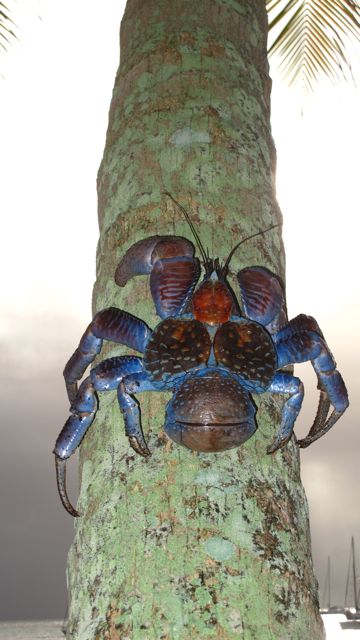
terns – all nesting peacefully next to each other. And lastly, catching huge coconut crabs
for the pot-luck bbq that night.
Suvarov can only be described as a pristine
atoll and after having done one of these excursions it is easy to accept that it is only
permitted to do these excursions with the guidance of the ranger and not with your
own dinghy. Just look at the pictures and make up your own mind.


The lagoon and the Pass are littered with sharks
and each boat seemed to have their special lot hanging around the perimeter of
the boat. Although they are ‘only’ reef sharks it takes a few days until you get used
to them. Then swimming amongst them becomes ok, but there are still no-go zones,
especially the spot where the fish are being cleaned.


Life for Harry and Anthony is not
luxurious. They get dropped off in April with basic supplies and live of
fishing, coconuts, crabs and whatever the yachts people can contribute. When we
were there they were waiting since 6 weeks already for the next supply boat to
arrive. It did arrive, with 2 drums of fuel and a battery. But then, they are
not starving and what a place to live …
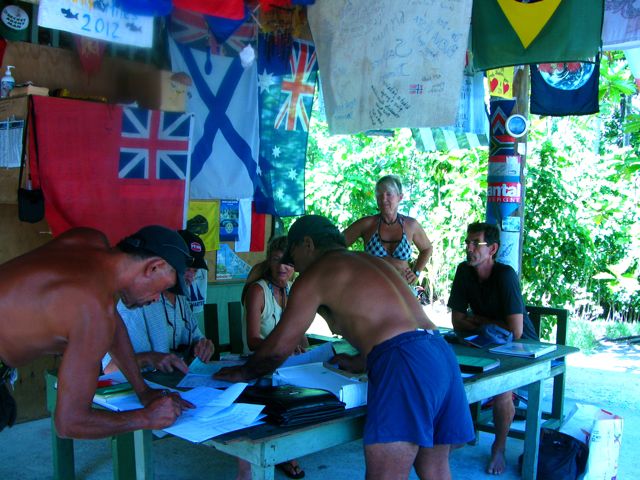
Suvarov Shelter is an extension of what Tom
Neale left behind and houses ‘the office’ and living quarters of the rangers.
Cooking is done on the open fire in the outhouse. The procedure of clearing in
and out of the Cook Islands is a pleasure compared to most official business we
had to endure during this trip. Although Harry wouldn’t allow me to look
through his official logbook to see which yachts have called in during the
season, we know that the top was 36 yachts at one time; we considered ourselves
fortunate, arriving with 4 and leaving with 8.




Apologies for bombarding you with all these
pictures, but it was hard to select some from the hundreds we took. Just a few more …
Suvarov – what a place.


Before us were 714 miles in southwesterly
direction to Vava’u, a group of islands in the north of Tonga. We left together
with 2 other yachts and the weather forecast was a mixed bag. Before we could
count on the more reliable southeasterly trade winds closer to Tonga knew we
had to cross the SPCZ – the South Pacific Convergence Zone, an area of unstable
tropical weather with thunderstorms developing out of nowhere producing very erratic
winds. It was textbook material. You could literally watch within an hour how a
massive white wall of cumulonimbus cloud sucked up all adjoining clouds and
turned into a dark front right before your eyes. For 2 days we were dodging
thunderstorms and lightning, looking for gaps in the fronts to escape through.
Then after a short lull we got into the trade wind belt and made a run for
Vava’u. On day 6 we were broad reaching down the northern coastline of the main
island under full sail with 8-9 knots trying to beat nightfall. While going
through the Pass we were greeted by 2 humpback whales and managed to drop
anchor with the last rays of light.
We opened a well-earned coldie and said
goodbye to yesterday – as we officially had crossed the dateline. During the
convention to establish the exact run of the dateline the Tongan King then
decided that he didn’t want his country to be at the end of the day. So by the
time we got up to greet the next morning we had jumped a day, our Sunday became
a Monday. We were lucky as on Sunday everything stops in Tonga and we wouldn’t
have been able to clear in, meaning we would have been confined to stay on our
boat for another day.
Was that luck or perfect timing ???


